Systems capability
Scorpion Automated Mortar System
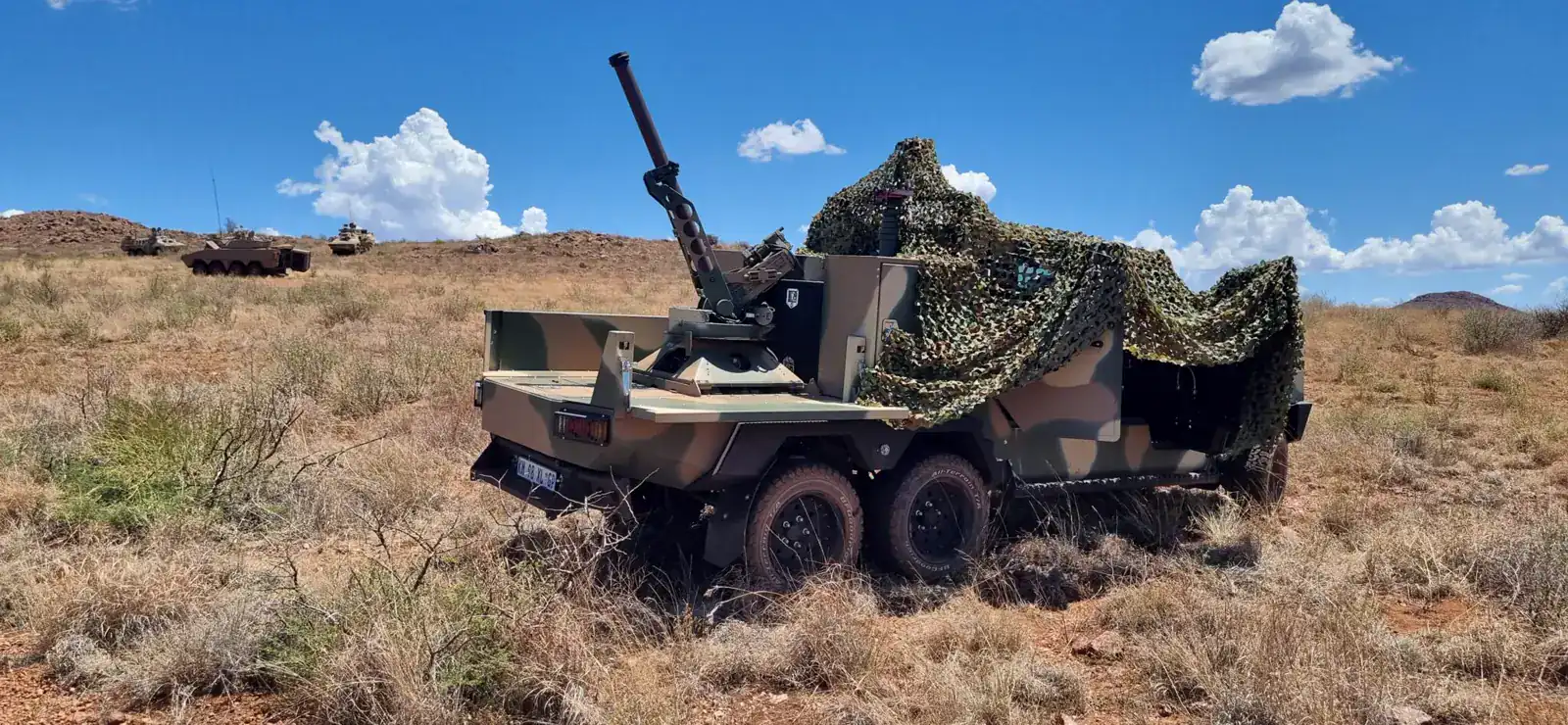
The Scorpion Automated Mortar System from African Defence Systems — also designated the Automated Mortar, Rocket and Fire Control System (AMRFCS) — is a vehicle-mounted mortar and fire control solution built for mobility, integrating a motorised weapon platform with fire control, navigation, observation, communications and vehicle systems.
The system
What is the Scorpion Automated Mortar System?
Scorpion is an integrated vehicle-mounted mortar system designed around mobility, fire control and platform flexibility. It can be configured for conventional mortar calibres from 60 mm through 82 mm and integrates the weapon platform with the digital and electronic systems required for a complete mobile solution.
The architecture can operate autonomously or as part of a higher-level command-and-control environment. Depending on the selected configuration, Scorpion can include:
- Motorised mortar platform
- Fire control system
- Navigation and orientation
- Observer sighting system
- Command display
- Communications equipment
- Power and communications distribution
- Vehicle integration
- Logistic and training support
- Alternative 107 mm rocket configuration
At a glance
Scorpion at a glance.
- Product type
- Vehicle-mounted automated mortar and fire control system
- ADS designation
- AMRFCS — Automated Mortar, Rocket and Fire Control System
- Mortar configurations
- 60 mm to 82 mm (incl. extended-range 60 mm)
- Alternative configuration
- 107 mm rocket pack (interchangeable)
- Vehicle architecture
- Customer-furnished, customer-specified or ADS-supplied
- Fire control
- ADS integrated fire-control software on rugged touchscreen computing
- Navigation
- Inertial navigation with GPS integration; GPS-independent capability
- Observation
- Mounted or dismounted; configurable day and night sensors
- Communications
- Integrated VHF combat-net radio; customer equipment subject to integration
- Operating architecture
- Autonomous or higher-level C2
- Support
- Logistics, documentation and operator/maintainer training
- Lifecycle
- Principal product elements identified as in production
- Provider
- African Defence Systems
Mobile architecture
Vehicle integration, platform flexibility and mobility.
Mobility is central to the Scorpion concept. Rather than treating the mortar and vehicle as unrelated systems, Scorpion combines the weapon, vehicle, navigation, fire control and supporting electronics into one integrated mobile architecture. It is described as designed for rapid deployment and suitable for installation on vehicles with the appropriate payload capacity.
Scorpion is not defined around one mandatory vehicle. ADS documentation describes a vehicle-independent integration concept extending from lightweight and air-deployable classes through to larger protected platforms, and suitable commercial-type vehicles can also be considered. The selected vehicle may be customer-furnished, customer-specified, or ADS-supplied — determined by payload, space, power, mobility and programme requirements.
Because every vehicle presents different mechanical, electrical and operational constraints, ADS defines the Scorpion installation around the selected platform. Integration engineering considers payload, dimensions, installation space, electrical power, crew positions, equipment mounting, communications, navigation equipment, operator displays, existing customer equipment and the required level of vehicle modification — with the objective of creating an integrated solution while limiting unnecessary modification to the base vehicle.
Fire control & navigation
Fire control, computing and resilient navigation.
Motorised weapon platform
The Scorpion architecture incorporates an electrically motorised weapon platform. ADS documentation identifies multiple motorised-platform configurations for light-to-medium mortar applications; the platform forms the mechanical interface between the weapon capability and the wider fire-control environment. Detailed weapon-control procedures remain within authorised technical documentation.
Integrated fire control
Scorpion includes an ADS fire control system as part of the vehicle architecture — rugged touchscreen computing hardware running configurable ADS fire-control software. System functions include the digital management of information required by the configured Scorpion architecture, with interfaces to other vehicle and system elements. The rugged tablet computer with a touchscreen colour display provides the operator interface in a compact vehicle-suitable format.
Inertial navigation with GPS
Navigation and orientation are a defined part of the architecture. An Inertial Navigation System provides vehicle navigation and system positioning, integrated with the wider vehicle and fire-control environment. The architecture can provide navigation independently from GPS while making use of GPS information when it is available — a more resilient posture than depending entirely on satellite positioning alone.
Observation
Observer sighting: mounted, dismounted, day and night.
Scorpion can incorporate an observer sighting capability as part of the complete system. The observer architecture can be configured in mounted or dismounted form depending on the programme requirement, allowing the observation function either to remain integrated with the vehicle or to be deployed separately.
Mounted configuration
A vehicle-mounted sighting pedestal can incorporate day and night sensing capability and associated observation equipment. The exact sensor package is selected according to customer requirements and available interfaces.
Dismounted configuration
A dismounted observation configuration allows the observation element to operate independently from the main Scorpion vehicle. It can use customer-furnished or selected standard observation equipment and can be configured with supporting communications interfaces where required.
Day and night capability, existing sensor integration
Configurations incorporating thermal imaging and other day/night observation equipment give the system a configurable observation capability rather than tying it to a fixed sensor suite. ADS is prepared to evaluate suitable existing customer sensors for integration, allowing a programme to retain compatible customer-furnished equipment where appropriate.
Communications & C2
Communications, power distribution and operating modes.
Communications are incorporated into the Scorpion architecture: a VHF combat-net radio, data communications and a dedicated Power and Communication Distribution Unit. The communications architecture is configured according to the selected system and customer requirement, and ADS documentation specifically allows customer-furnished radios to be considered on a case-by-case basis where technically practical.
The dedicated Power and Communication Distribution Unit handles distribution and conditioning of electrical power and management of relevant system communications interfaces — supporting the relationship between the weapon platform, computing, navigation, communications and other onboard systems.
Scorpion is designed for more than one operating architecture. It supports autonomous operation as a self-contained mobile capability, or operation within a higher-level C2 network as one element of a wider command-and-control environment. Where a programme requires broader battlefield-management capability, Scorpion can be considered alongside the existing ADS Fire Control Systems offering.
An alternative Scorpion configuration incorporates a 107 mm rocket pack, designed as an interchangeable configuration with the mortar platform — providing additional configurability while retaining the common vehicle, system-integration and supporting electronic environment. Detailed weapon specifications remain within controlled technical documentation.
Programme & support
Support, production maturity and configuration.
The Scorpion offering includes a defined logistic-support architecture: operational documentation, operator and maintainer training material and courses, support documentation, design and production data, and environmental qualification documentation. The final support package is adapted according to the customer’s requirements.
ADS can assess existing customer-furnished vehicles, radios, observation sensors, communications equipment and supporting infrastructure — where suitable equipment can be retained and integrated it becomes part of the final Scorpion configuration, allowing the programme to balance new capability with existing assets.
The Scorpion product architecture identifies its principal launcher, navigation, observer, fire-control and support elements as in production. ADS source documentation records Scorpion/AMRFCS demonstration activity across multiple vehicle and user configurations and identifies the system as having operational-use experience — providing credible programme context while maintaining responsible public disclosure.
Where required, Scorpion can operate alongside other ADS capability families:
- Fire Control Systems — AS4000 provides the broader battlefield-management and fire-control context for a Scorpion deployment.
- Communication Systems — mounted, man-portable and specialised communications systems that can support wider programme requirements.
- Mortar Optical Heading & Reference Sighting — digital heading and reference for conventional mortar modernisation.
- Drone Integration Systems — connecting unmanned aircraft with wider battlefield-management environments.
Integration & disclosure
Technical detail, shared responsibly.
The public site describes Scorpion at product and system-architecture level. Detailed weapon performance, ballistic information, engagement procedures, automation logic, platform-specific interfaces and operational system configuration are provided through controlled engagement with authorised customers and programme partners.
Frequently asked
Scorpion questions.
What is the Scorpion Automated Mortar System?
Scorpion is a vehicle-mounted automated mortar and fire control system from African Defence Systems. It integrates a motorised weapon platform with fire control, navigation, observation, communications and supporting vehicle systems.
What does AMRFCS mean?
AMRFCS stands for Automated Mortar, Rocket and Fire Control System, the system designation used in ADS product documentation for the Scorpion architecture.
What mortar calibres does Scorpion support?
ADS documentation identifies Scorpion as supporting mortar configurations from 60 mm through 82 mm, including extended-range 60 mm and relevant 82 mm families.
Is Scorpion tied to one specific vehicle?
No. ADS describes Scorpion as vehicle independent. The system can be integrated into suitable customer-furnished, customer-specified or ADS-supplied vehicle platforms.
Can Scorpion operate independently?
Yes. ADS documentation identifies autonomous operation as one of the supported system architectures.
Can Scorpion operate within a command-and-control network?
Yes. The system can also operate within a higher-level C2 network where that architecture forms part of the programme requirement.
Does Scorpion include digital fire control?
Yes. Fire-control software and rugged touchscreen computing form part of the defined Scorpion architecture.
Does Scorpion include navigation?
Yes. Navigation and orientation are core Scorpion components, including inertial-navigation capability and integration with GPS information where available.
Can Scorpion operate when GPS is unavailable?
ADS documentation identifies inertial navigation for navigation and positioning independently from GPS, while allowing GPS information to be used when available.
Does Scorpion include an observer system?
Yes. The Scorpion architecture provides both mounted and dismounted observer configurations.
Can existing observation sensors be used?
Potentially. ADS documentation states that compatible customer-furnished sensors can be discussed for integration according to the programme requirement.
Can existing military radios be integrated?
Potentially. ADS documentation allows customer-furnished radios to be considered on a case-by-case basis.
Does Scorpion support day and night observation?
Yes. The observer architecture supports configurable day and night sensor capability.
Is there a rocket configuration?
Yes. ADS documentation identifies an alternative 107 mm rocket pack configuration that is interchangeable with the mortar platform.
Does ADS provide training and logistic support?
Yes. The Scorpion product documentation identifies operator and maintainer training, support documentation and broader logistic-support material as part of the system offering.
Is Scorpion an operationally mature system?
ADS documentation identifies the major Scorpion system elements as in production and records both demonstration and operational-use experience.