Systems capability
Drone Integration Systems
African Defence Systems provides drone integration systems that bring aircraft control, communications and mission information into a focused software environment for defence applications — with a single interface to the drone and integration with the AS4000 Battlefield Management and Fire Control System where required.
The capability
What is an ADS Drone Integration System?
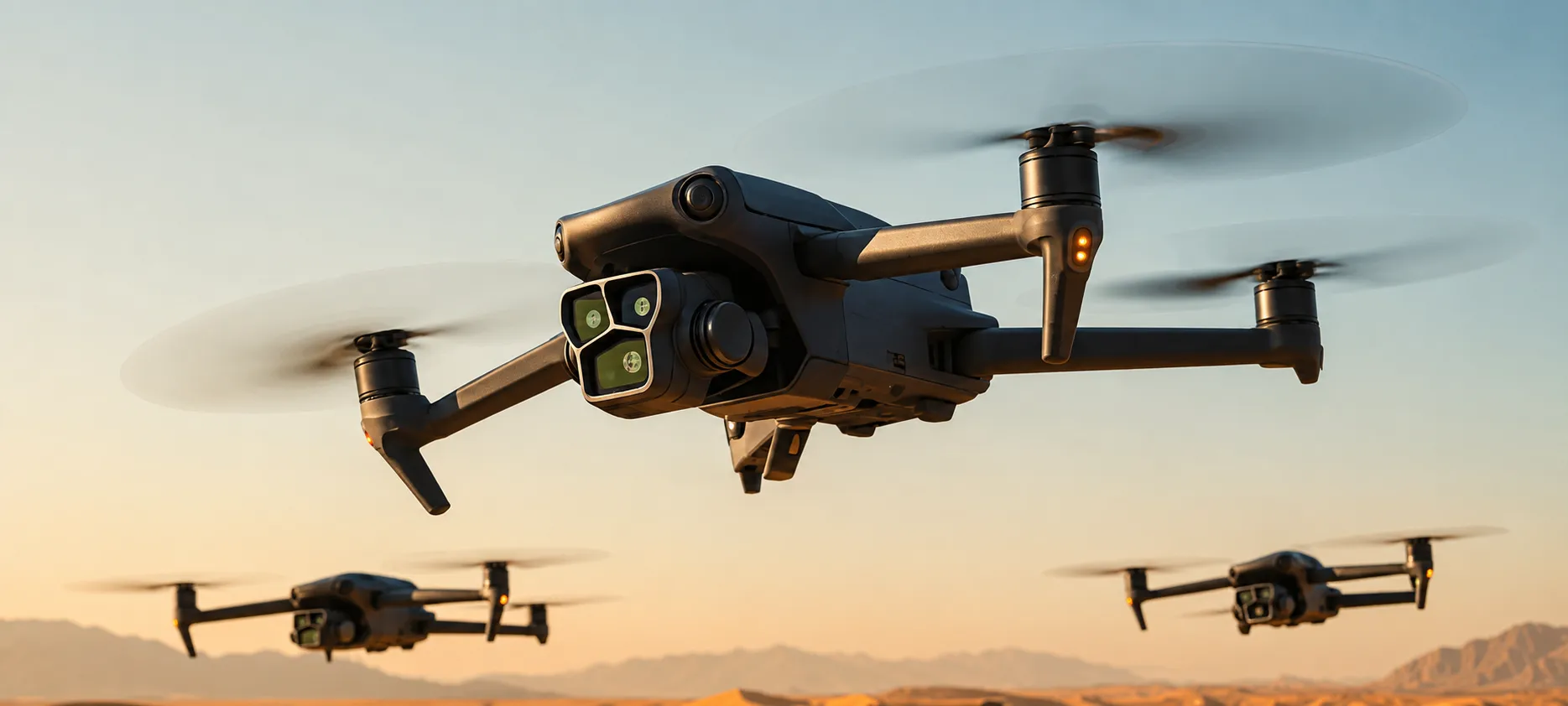
ADS Drone Integration Systems combine drone-control software, computing hardware, communications and system interfaces into an integrated defence capability. The objective is to allow unmanned aircraft to operate as part of a wider information environment rather than as a disconnected standalone application.
Depending on the programme requirement, the capability can support:
- Drone control through dedicated software
- Handheld tablet-based operation
- Integrated communications
- Target-position computation
- Target and point-of-interest data exchange
- Interface with battlefield-management systems
- AS4000 integration
- Forward Observer integration
- Configurable platform interfaces
At a glance
Drone integration at a glance.
- Capability type
- Military drone / UAS systems integration
- Core technology
- Dedicated drone-control software
- Operator hardware
- Handheld tablet computer
- Control architecture
- Single software interface to drone
- Platforms
- Configured according to compatible aircraft interfaces
- Aircraft scope
- Configured per programme; single-aircraft architecture with programme-specific extensions
- Data capability
- Target-position and point-of-interest information
- Battlefield integration
- AS4000 / BMFCS
- Observer role
- Forward Observer interface
- Communications
- Integrated as part of system architecture
- Provider
- African Defence Systems
Software-led control
Single software interface, handheld operation.
Software is at the centre of the ADS drone-integration approach. Dedicated control software provides the operator with a focused interface to the unmanned platform — the control layer through which the drone is incorporated into the wider system architecture. This allows the aircraft, communications and information interfaces to be considered together rather than treating each as an unrelated subsystem.
The ADS architecture provides a single software interface to the drone. Bringing relevant drone interaction into a common interface simplifies the relationship between the operator, aircraft and connected systems. The final interface is configured according to the selected unmanned platform and the technical interfaces available for integration.
The drone-control capability can be operated using a handheld tablet computer running the ADS control software. A portable computing approach provides flexibility for applications where the operator must work away from a fixed command workstation. The selected computing hardware is defined according to the environmental, communications and programme requirements.
Communications & configuration
Integrated communications and programme-specific configuration.
Communications form an important part of drone-system integration. ADS approaches drone control and communications as components of the same system architecture — the communications configuration is considered together with aircraft interface requirements, control software, operator hardware, existing communications equipment, battlefield-management interfaces and wider command-and-control requirements. The final solution is engineered around the customer’s communications environment and available interfaces.
The ADS drone-integration architecture is defined around single-aircraft control with a dedicated software interface. Where a customer programme calls for coordinated use of additional unmanned platforms or a wider unmanned-system architecture, the specific implementation, aircraft compatibility and communications architecture are defined during system engineering rather than treated as an off-the-shelf configuration.
Information exchange
Target-position and point-of-interest data.
ADS drone-control software includes functionality for calculating target-position information, allowing relevant positional information derived through the drone environment to be made available within the configured system. The public website intentionally describes this capability at system level; detailed operational methods and procedures are provided only within authorised programme documentation.
The architecture also supports the uploading and downloading of target or point-of-interest information, allowing authorised data to move between the drone environment and connected systems where the required integration has been configured. The result is a more connected information architecture in which relevant drone-derived information can be used by other authorised elements instead of remaining isolated within the drone-control application.
Battlefield-management integration
AS4000 integration and the Forward Observer role.
A key capability of the ADS drone-integration architecture is its ability to interface with the AS4000 Battlefield Management and Fire Control System. Within a configured AS4000 environment, the drone can provide an additional observation capability and interface with the system in a Forward Observer role — connecting the unmanned aircraft with the broader battlefield-management environment rather than treating it as a separate information source.
The digital relationship connects the drone through the control software, communications and observation information into AS4000, allowing drone-derived information to be integrated into authorised AS4000 workflows where required by the programme. Detailed operational workflows and fire-control procedures are intentionally not published on the public website; they remain part of controlled system documentation.
Where a programme requires broader integration, Drone Integration Systems can be considered alongside other ADS capability families:
- Fire Control Systems — AS4000 provides battlefield-management and fire-control capability for indirect-fire assets and can interface with the ADS drone environment.
- Communication Systems — mounted, man-portable and specialised communications equipment for defence applications.
- Scorpion Automated Mortar System — vehicle-mounted weapon platform with fire-control, navigation and supporting system integration.
- Mortar Optical Heading & Reference Sighting — optical heading and reference capability for conventional mortar applications.
Programme fit
Designed around the requirement.
Drone programmes may begin with an existing aircraft, existing communications equipment or an established battlefield-management environment. ADS defines the integration requirement around existing equipment where suitable technical interfaces are available — assessing the unmanned aircraft platform, existing control interfaces, communications equipment, operator computing hardware, target and point-of-interest data, battlefield-management interfaces, AS4000 connectivity and existing customer infrastructure.
This is particularly important for drone systems because aircraft, communications, control interfaces and mission-system architectures vary significantly between platforms. Before a final architecture is established, ADS assesses platform compatibility, communications requirements and the intended integration environment so that the solution is shaped around the actual programme rather than assuming that every customer requires an identical platform.
Drone integration requires more than a flight-control application. ADS treats the aircraft, control software, computing hardware, communications, target/point-of-interest information and battlefield-management interfaces as part of one architecture — helping avoid the creation of another disconnected battlefield application.
Integration & disclosure
Technical detail, shared responsibly.
The public site describes ADS Drone Integration Systems at capability level. Aircraft-specific interfaces, communications architecture, operational workflows, platform compatibility and detailed system configuration are defined through a controlled consultation process with authorised customers and programme partners.
Discuss this capabilityFrequently asked
Drone integration questions.
What are ADS Drone Integration Systems?
ADS Drone Integration Systems combine dedicated drone-control software, communications, computing hardware and interfaces that allow unmanned aircraft to operate within a wider defence and battlefield-management environment.
Does ADS provide drone-control software?
Yes. ADS documentation identifies dedicated drone-control software as a core part of the capability.
How is the drone controlled?
The ADS source material identifies a handheld tablet computer running the drone-control software as part of the system architecture.
Is the system designed for single or multiple aircraft?
The core ADS architecture is defined around single-aircraft control with a dedicated software interface. Where a customer programme requires coordinated use of additional unmanned platforms, the specific implementation, aircraft compatibility and communications architecture are defined during system engineering.
Can the drone system calculate target-position information?
Yes. ADS documentation identifies target-position computation as a function of the drone-control capability.
Can target or point-of-interest information be exchanged?
Yes. The system supports uploading and downloading target or point-of-interest information within the configured architecture.
Can ADS Drone Integration connect with AS4000?
Yes. ADS documentation identifies an interface between the drone-control capability and the AS4000 Battlefield Management and Fire Control System.
Can the drone operate as part of the AS4000 Observer environment?
ADS documentation identifies an interface to the BMFCS in a Forward Observer role. The precise implementation depends on the configured system architecture.
Does ADS integrate communications as part of the drone solution?
Yes. Communications form part of the system-integration capability and are assessed according to the aircraft, control environment and customer requirements.
Is the solution tied to one specific drone platform?
The supplied ADS source material does not define a single mandatory aircraft platform. Platform compatibility and available interfaces are assessed during the solution-definition process.
Does ADS publish detailed drone operating procedures?
No. The public website provides capability-level information. Detailed interfaces, communications architecture and operating concepts are shared through controlled programme engagement.